Initial Enumeration
External Recon and Enumeration Principles
- First step is external recon before anything this includes
- validating information from given scope
- ensuring appropriate actions against appropriate scope
- looking for public info such as leaked documents, github repos or credential in initital repos
What Are We Looking For?
| Data Point | Description |
|---|---|
IP Space | Valid ASN for our target, netblocks in use for the organization's public-facing infrastructure, cloud presence and the hosting providers, DNS record entries, etc. |
Domain Information | Based on IP data, DNS, and site registrations. Who administers the domain? Are there any subdomains tied to our target? Are there any publicly accessible domain services present? (Mailservers, DNS, Websites, VPN portals, etc.) Can we determine what kind of defenses are in place? (SIEM, AV, IPS/IDS in use, etc.) |
Schema Format | Can we discover the organization's email accounts, AD usernames, and even password policies? Anything that will give us information we can use to build a valid username list to test external-facing services for password spraying, credential stuffing, brute forcing, etc. |
Data Disclosures | For data disclosures we will be looking for publicly accessible files ( .pdf, .ppt, .docx, .xlsx, etc. ) for any information that helps shed light on the target. For example, any published files that contain intranet site listings, user metadata, shares, or other critical software or hardware in the environment (credentials pushed to a public GitHub repo, the internal AD username format in the metadata of a PDF, for example.) |
Breach Data | Any publicly released usernames, passwords, or other critical information that can help an attacker gain a foothold. |
Where Are We Looking?
| Resource | Examples |
|---|---|
ASN / IP registrars | IANA, arin for searching the Americas, RIPE for searching in Europe, BGP Toolkit |
Domain Registrars & DNS | Domaintools, PTRArchive, ICANN, manual DNS record requests against the domain in question or against well known DNS servers, such as 8.8.8.8. |
Social Media | Searching Linkedin, Twitter, Facebook, your region's major social media sites, news articles, and any relevant info you can find about the organization. |
Public-Facing Company Websites | Often, the public website for a corporation will have relevant info embedded. News articles, embedded documents, and the "About Us" and "Contact Us" pages can also be gold mines. |
Cloud & Dev Storage Spaces | GitHub, AWS S3 buckets & Azure Blog storage containers, Google searches using "Dorks" |
Breach Data Sources | HaveIBeenPwned to determine if any corporate email accounts appear in public breach data, Dehashed to search for corporate emails with cleartext passwords or hashes we can try to crack offline. We can then try these passwords against any exposed login portals (Citrix, RDS, OWA, 0365, VPN, VMware Horizon, custom applications, etc.) that may use AD authentication. |
Identifying Hosts
Using Wireshark
┌─[htb-student@ea-attack01]─[~]
└──╼ $sudo -E wireshark

11:28:20.487     Main Warn QStandardPaths: runtime directory '/run/user/1001' is not owned by UID 0, but a directory permissions 0700 owned by UID 1001 GID 1002
<SNIP>
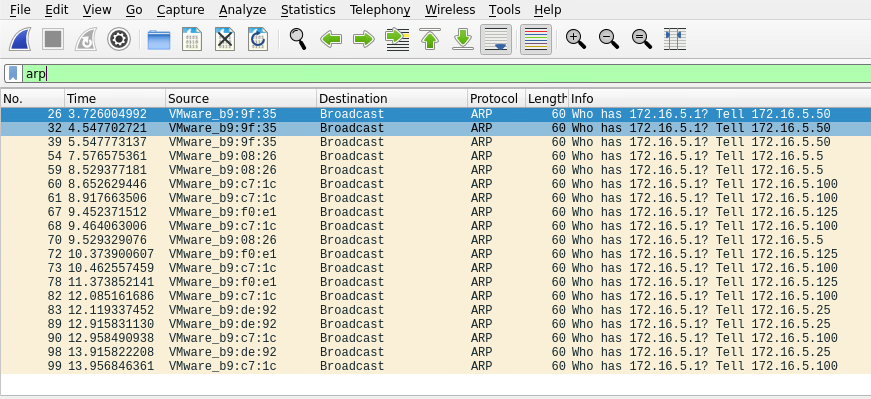
ARP packets make us aware of the hosts: 172.16.5.5, 172.16.5.25 172.16.5.50, 172.16.5.100, and 172.16.5.125.
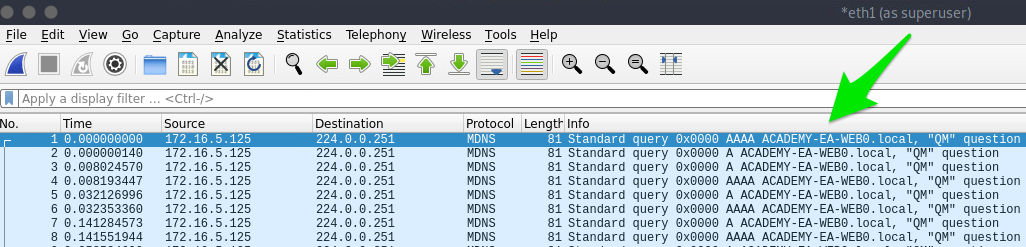
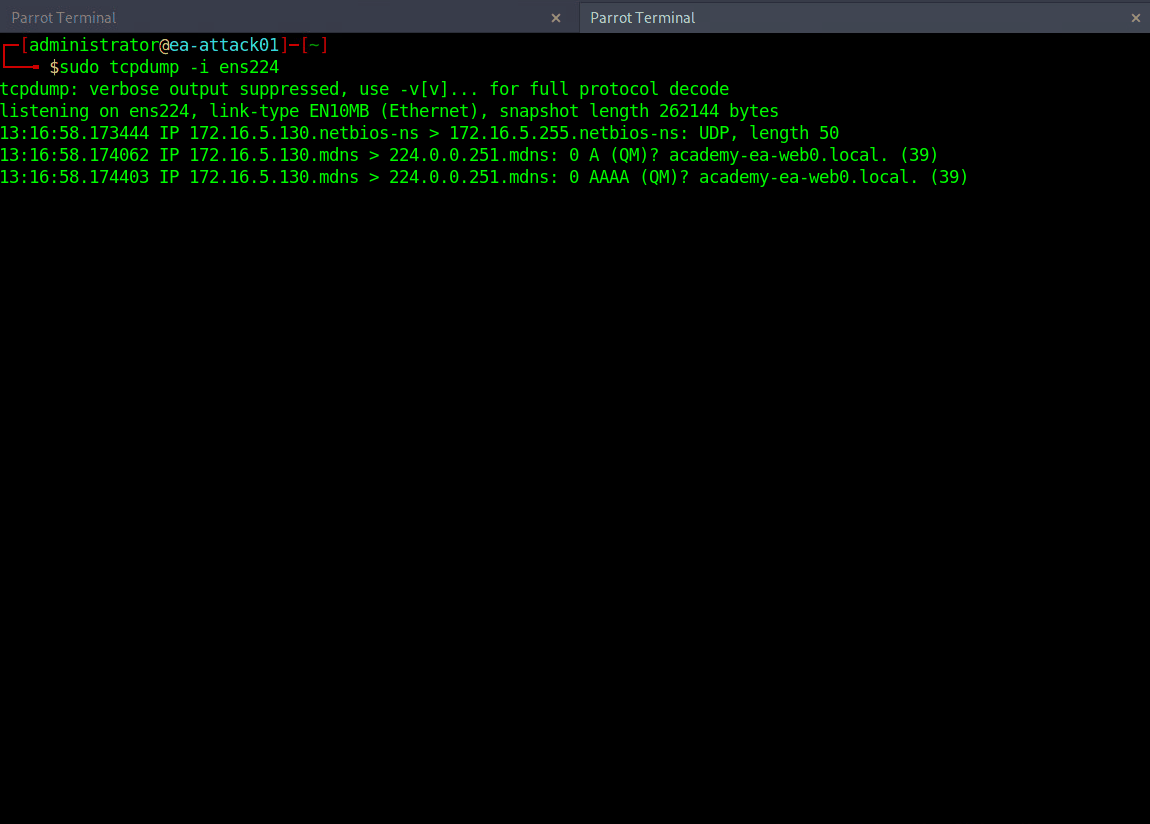
Using Tcpdump
hexadivine@htb[/htb]$ sudo tcpdump -i ens224
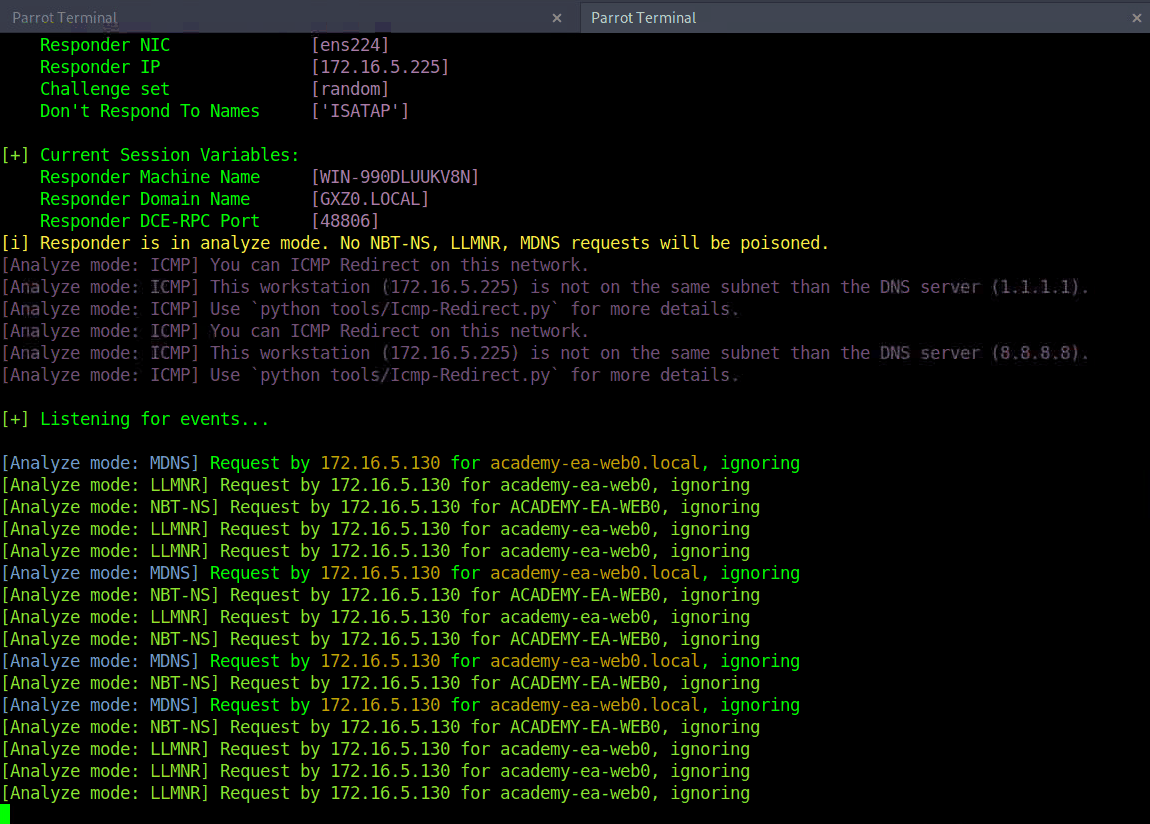
Using Responder
sudo responder -I ens224 -A
Nmap Scanning
sudo nmap -v -A <ip>
Identifying Users
Kerbrute - Internal AD Username Enumeration
- If we dont have list of users we need to bruteforce in this case using
jsmith.txtorjsmith2.txtuser lists from Insidetrust. - We can point Kerbrute at the DC we found earlier and feed it a wordlist.
Installing Kerbrute
hexadivine@htb[/htb]$ sudo git clone https://github.com/ropnop/kerbrute.git

Cloning into 'kerbrute'...
remote: Enumerating objects: 845, done.
remote: Counting objects: 100% (47/47), done.
remote: Compressing objects: 100% (36/36), done.
remote: Total 845 (delta 18), reused 28 (delta 10), pack-reused 798
Receiving objects: 100% (845/845), 419.70 KiB | 2.72 MiB/s, done.
Resolving deltas: 100% (371/371), done.
hexadivine@htb[/htb]$ sudo make all

go: downloading github.com/spf13/cobra v1.1.1
go: downloading github.com/op/go-logging v0.0.0-20160315200505-970db520ece7
go: downloading github.com/ropnop/gokrb5/v8 v8.0.0-20201111231119-729746023c02
go: downloading github.com/spf13/pflag v1.0.5
go: downloading github.com/jcmturner/gofork v1.0.0
go: downloading github.com/hashicorp/go-uuid v1.0.2
go: downloading golang.org/x/crypto v0.0.0-20201016220609-9e8e0b390897
go: downloading github.com/jcmturner/rpc/v2 v2.0.2
go: downloading git
hexadivine@htb[/htb]$ ls dist/

kerbrute_darwin_amd64  kerbrute_linux_386  kerbrute_linux_amd64  kerbrute_windows_386.exe  kerbrute_windows_amd64.exe
hexadivine@htb[/htb]$ ./kerbrute_linux_amd64

    __             __               __
   / /_____  _____/ /_  _______  __/ /____
  / //_/ _ \/ ___/ __ \/ ___/ / / / __/ _ \
 / ,< /  __/ /  / /_/ / /  / /_/ / /_/  __/
/_/|_|\___/_/  /_.___/_/   \__,_/\__/\___/

Version: dev (9cfb81e) - 02/17/22 - Ronnie Flathers @ropnop

This tool is designed to assist in quickly bruteforcing valid Active Directory accounts through Kerberos Pre-Authentication.
It is designed to be used on an internal Windows domain with access to one of the Domain Controllers.
Warning: failed Kerberos Pre-Auth counts as a failed login and WILL lock out accounts

Usage:
  kerbrute [command]
Enumerating Users with Kerbrute
hexadivine@htb[/htb]$ kerbrute userenum -d INLANEFREIGHT.LOCAL --dc 172.16.5.5 jsmith.txt -o valid_ad_users

2021/11/17 23:01:46 >  Using KDC(s):
2021/11/17 23:01:46 >   172.16.5.5:88
2021/11/17 23:01:46 >  [+] VALID USERNAME:       jjones@INLANEFREIGHT.LOCAL
2021/11/17 23:01:46 >  [+] VALID USERNAME:       sbrown@INLANEFREIGHT.LOCAL
2021/11/17 23:01:46 >  [+] VALID USERNAME:       tjohnson@INLANEFREIGHT.LOCAL
2021/11/17 23:01:50 >  [+] VALID USERNAME:       evalentin@INLANEFREIGHT.LOCAL

 <SNIP>
Identifying Potential Vulnerabilities
There are several ways to gain SYSTEM-level access on a host, including but not limited to:
- Remote windows exploits like MS08-067, EternalBlue, or BlueKeep.
- using a service running in the context of the
SYSTEM account, or abusing the service accountSeImpersonateprivileges using Juicy Potato - Local privilege escalation flaws in Windows operating systems such as the Windows 10 Task Scheduler 0-day.
- Gaining admin access on a domain-joined host with a local account and using Psexec to launch a SYSTEM cmd window
By gaining SYSTEM-level access on a domain-joined host, you will be able to perform actions such as, but not limited to:
- Enumerate the domain using built-in tools or offensive tools such as BloodHound and PowerView.
- Perform Kerberoasting / ASREPRoasting attacks within the same domain.
- Run tools such as Inveigh to gather Net-NTLMv2 hashes or perform SMB relay attacks.
- Perform token impersonation to hijack a privileged domain user account.
- Carry out ACL attacks.